The four terms
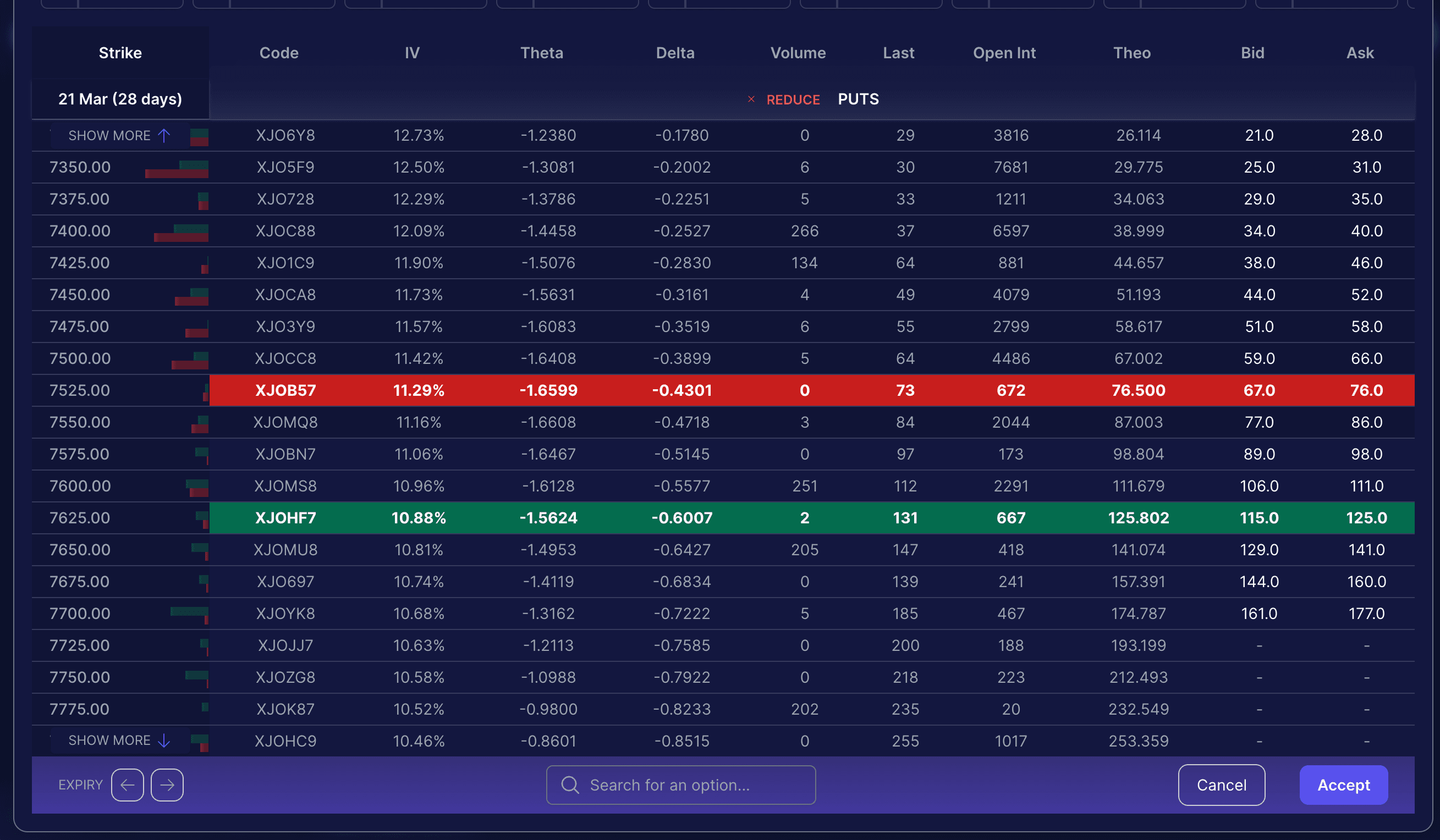
Every option contract is defined by four things: the underlying asset it is written over, the strike price at which the transaction would happen, the expiry after which the right lapses, and whether it is a call or a put.
A call gives its buyer the right to buy the underlying at the strike. A put gives its buyer the right to sell at the strike. Neither obliges the buyer to do anything — that is what the premium purchases. The obligation sits entirely with the writer on the other side of the contract.
This is the asymmetry that makes options behave unlike shares. A share is a stake in a company that you own outright. An option is an agreement with a fixed end date, and its value depends on where the underlying sits relative to the strike as that date approaches.
Buying and writing are not mirror images
It is tempting to treat writing an option as simply the opposite of buying one. The payoff diagrams do mirror each other, but the practical positions do not: a buyer's worst case is known on day one, while a writer's is not, and only the writer carries a margin obligation.
| Position | Premium | Right or obligation | Risk |
|---|---|---|---|
| Long call | Pay premium | Right to buy the shares at the strike | Loss limited to the premium paid |
| Long put | Pay premium | Right to sell the shares at the strike | Loss limited to the premium paid |
| Written call | Receive premium | Obligation to deliver the shares at the strike if exercised | Uncovered, the loss is theoretically unlimited as the price rises |
| Written put | Receive premium | Obligation to buy the shares at the strike if exercised | Loss grows as the price falls toward zero |
Writing an uncovered call is the position most often underestimated. Because there is no ceiling on how far a share price can rise, there is no fixed maximum loss — which is why writers post margin and buyers do not. How ASX margins work →
Standardisation
What makes an exchange-traded option different
An ASX exchange-traded option is standardised. The contract size, the available strikes and the expiry dates are set by the exchange rather than negotiated, which is what allows the same contract to be traded repeatedly by different people at a quoted market price.
Standardisation also changes who you are dealing with. When a trade is registered, ASX Clear becomes the counterparty to both sides. Neither party is relying on the other to perform — they are each facing the clearing house. This is also why the clearing house, not your counterparty, sets the margin a writer must post.
Contract specifications — including contract size, strike intervals, expiry dates and whether an option is American or European style — are published by ASX and can change. Check the current specification for the specific contract you are looking at rather than assuming a rule of thumb holds.
Where the price of an option comes from
A premium has two components. Intrinsic value is the part that would be realised by exercising immediately — how far in the money the strike sits. Everything above that is time value: the market's price for the possibility that the option becomes more valuable before it expires.
Time value is where volatility enters. A wider expected range of outcomes makes that possibility worth more, which is why two options with identical strikes and expiries can trade at very different premiums on different underlyings.
Read about implied volatility and IV rank →Time value decays toward zero as expiry approaches, and the decay is not linear. An option that is still out of the money close to expiry can lose value quickly even if the underlying does not move.